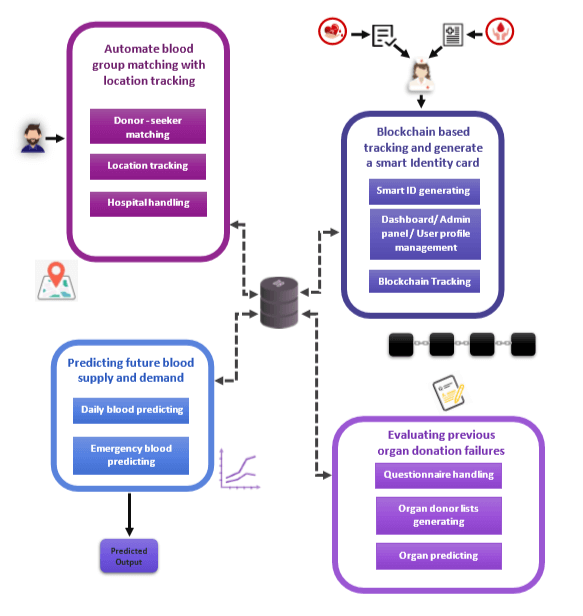
Overall research contains a unique web based system which supports to both desktops and mobiles. Users are mainly donors, seekers and healthcare personals. Seekers may be either healthcare personals /officers or general seekers. The proposed system gives the procedural approach of how to bridge the gap between Recipient, Donor, and Blood Banks. This Application will provide a common ground for all the three parties (i.e. Recipient, Donor, and Blood Banks) and will ensure the fulfillment of demand for Blood requested by Recipient and/or Blood Bank. The proposed system provides the best solution for the Sri Lankan Health sector.
System Design: “LifeShare” system has developed for 4 components as follows;
A. Block chain based tracking and generate a smart Identity
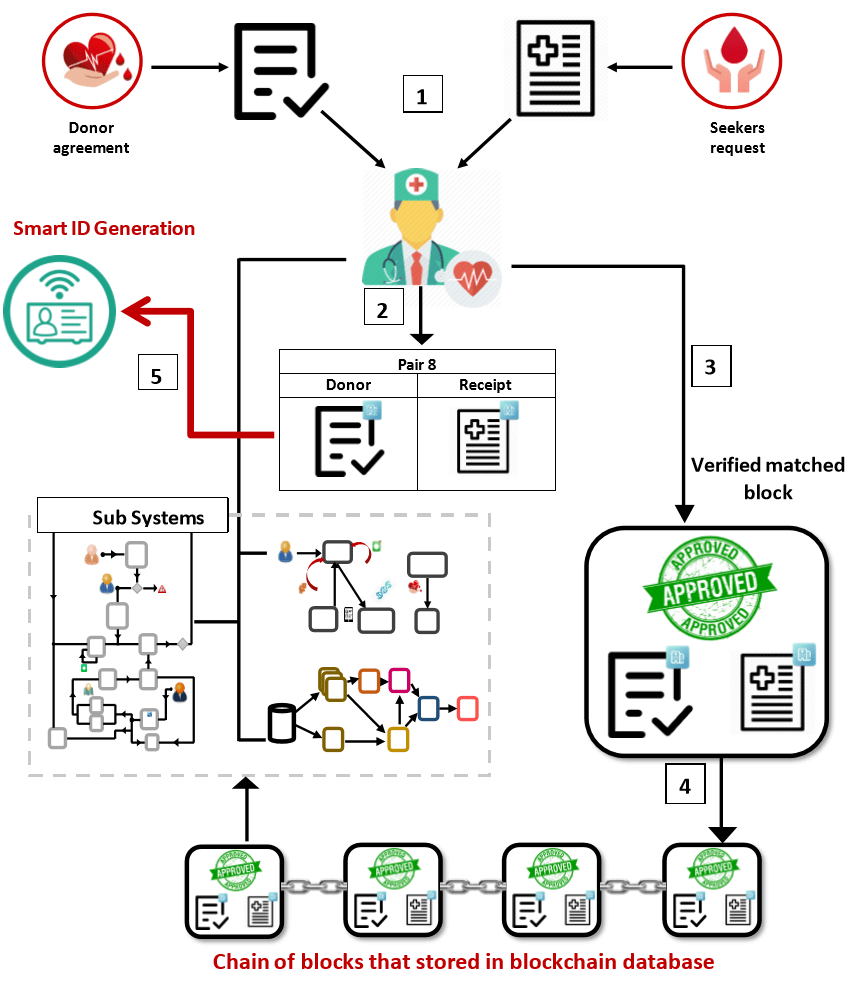
For Blockchain based component process system generates a smart identity card for donors and recipients after verified data accuracy. So, they can share their identity with main health organizations by linking their private key which can remains data non-identifiable to those without the key. The donor and recipient record can be seen as a global database, based on Blockchain technology, secured with cryptographic tools. Confidentiality and privacy can be achieved using the encryption tools and techniques.
Smart Identity uses the Ethereum blockchain to represent an identity using a smart contract, attributes can be added by the identity owner and are stored in hash form. This is the Smart Identity contract as used by the Smart Identity instance. It describes the core functionality required as part of a Smart Identity contracts with encryption keys, attributes & endorsements. A Smart ID is an Ethereum Smart Contract address. The smart contract must be constructed using valid Smart ID bytecode. It provides access to identity management commands and stores hash representations of identity data. Smart ID enables disconnected and duplicated patients information records, to widespread integration with a distributed master identity record. Users are able to create an identity profile, and allow trusted users, including institutions, to verify its authenticity. Users can then interact between one another directly, safe in the knowledge that their counterparty is who they say they are.
B. Automate the blood group matching with location tracking system
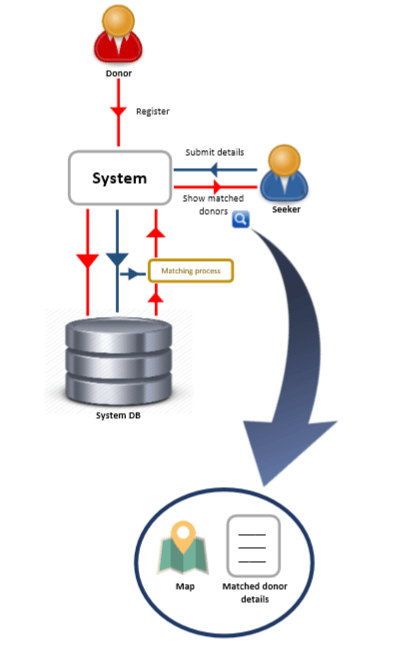
According to auto matching part, a person willing to become a blood donor has to perform all the compulsory blood tests required before donating blood. Then user can get the medical eligibility details. After all he/she must register into the system. If the person is found to be an eligible donor, personal details and the eligibility details will be fed into the system database of eligible donors by healthcare personnel. An email and notification will automatically be sent to the user. After that system will be able to track and locate the user whenever required. Healthcare personnel send a query using the web application to find donors of the required blood group. The query gives a list of all donors with the required blood group together with a notification for those donors who have their tracking option on. Actually, there are 2 lists. One is nearest donors with location. Other one is non-nearest donors. Location is tracked by GPS location service. To find the best matches among the donors available with the help of Machine Learning based decision tree. In this method, blood factors of the person who needs blood, will be compared with blood factors of all donors in database. This system is different than others because it uses Automation method for detecting the best matched donors. It has also the feature that if a person donates blood one time then he will be not shown in the map for next four months because it’s not healthy to donate blood more than once in four months. App will filter only those people who are eligible to donate blood according to age and last donated date. So the all tracking and automating methodologies are depend on databases. And not as an independent document. Please do not revise any of the current designations.
C. Predicting future blood supply and demand in Sri Lanka
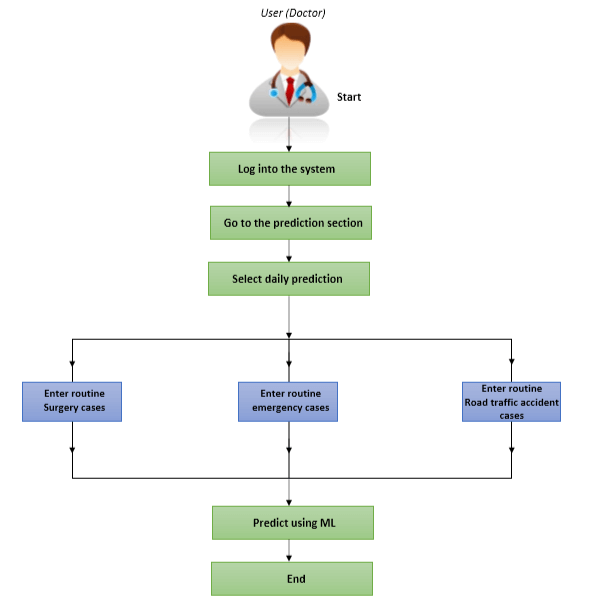
When Predicting future blood supply and demand in Sri Lanka the system predict the blood volume for the hospitals considering about main three cases usually, daily happened in hospitals of Sri Lanka.
1. Routine surgery cases
2. Emergency surgery cases
3. Road traffic surgery cases
Data sets that created contains linear regression model to predict the blood according to those cases. In statistics, linear regression is a linear approach to modeling the relationship between a scalar response and one or more explanatory variables. The case of one explanatory variable is called simple linear regression. For more than one explanatory variable, the process is called multiple linear regression. So in here we used simple linear regression to predict the blood volume. Then we deployed the model using flask with react Js. Also we use the react graphs to show the predicted output graphically. Other than that, there are four types of blood loss classes in the medicine field. But in our system we use the average volume for each class. (Class 1- 650ml,Class 2 – 1250ml,Class 3 – 1750ml,Class 4 – 2500ml).
First the doctor should select the blood loss class. Then number of patients for the given blood loss class have to be concerned according to blood groups. Then the doctor can save data and predict the output for the given class or go forward and add the other blood loss class details as above scenario. Likewise, the doctor can add the details of all patients according to blood loss class separately and predict the total blood volume need for the patients according to blood groups.
D. Evaluating previous organ donation failures in Sri Lanka and find solutions by system’s approach.
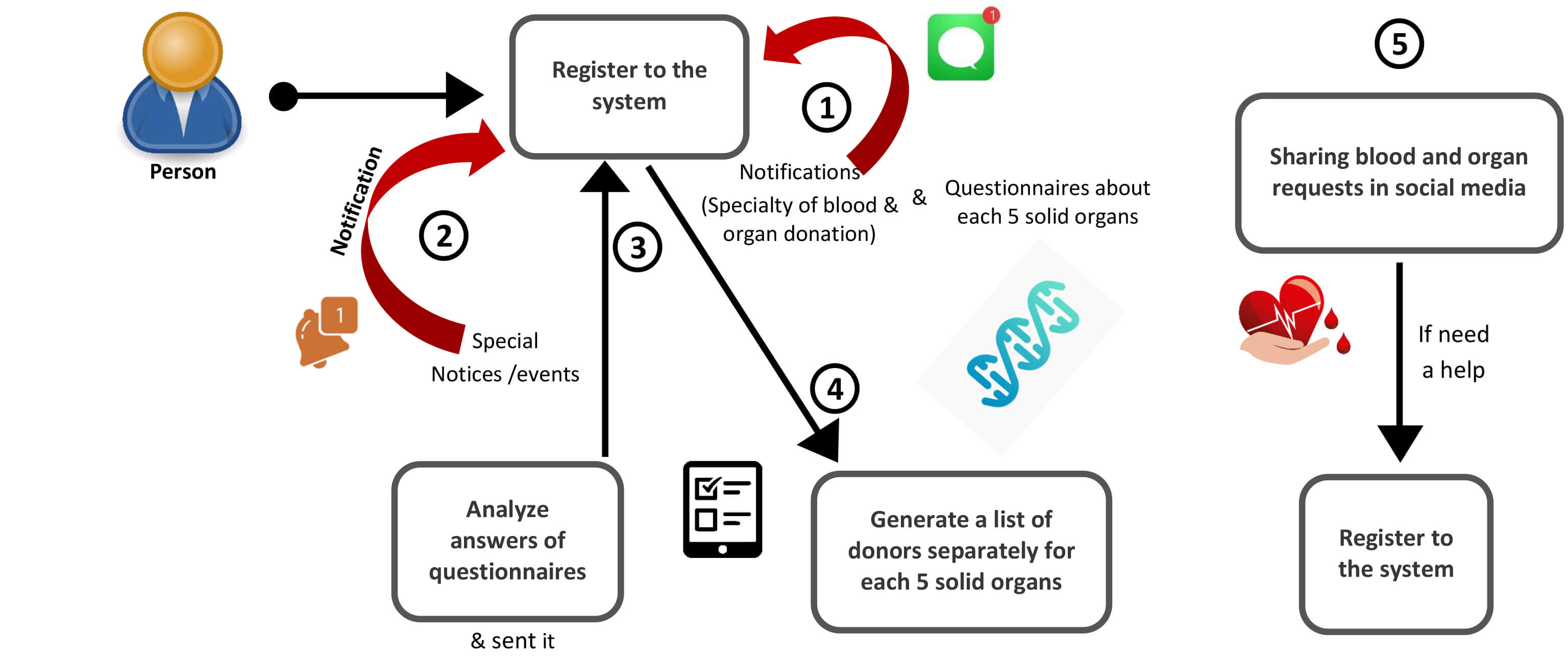
As the interest in organ donation is relatively low, after developed this system helped to improve the attitude of people toward organ donation. This research seeks to identify the level of knowledge, attitude and commitment among people by updating special notices and news. System generates a list of donors separately who are eligible to donate each organ by using Machine learning with python. And also, daily organ prediction was done by using ML model using flask. It was able to introduce special features in this research part integrating to our platform. Other special feature was sharing the blood and organ request in social media or via SMS to spread the message through the society. By developing a questionnaire circulated to public with regard to have knowledge on organ donation for each solid organ and analyze answers of those questionnaires. The special notices and notifications send to users includes information, circulars and rules about donating blood and organs. Those functions were done by using Artificial intelligence.
React JS technology has used to develop the User interfaces and Node JS, Java for back end parts. Visual Studio Code, Intellij and Sublime text are tools for React JS, Node JS and Java parts implementations. MySQL workbench and XAMPP used for database connection. Algorithms have created in python language, by using PyCharm. This community-based cross-sectional study was conducted among 205 people living in different districts in Sri Lanka. By this system analyzes were carried out using pretested questionnaire, which included the details on organ donation for each solid organ. Data were entered into Excel and analyzed using Statistical Package.